Friday, March 31, 2017

A 7-Year 10-Meter Es Propagation Study Using PropNET - Part 5 of 5

Conclusions About 10-Meter Es Propagation:

In my 38 years of monitoring and working these phenomena, I have heard many theories as to their generation and occurrence. Some of these theories that have been proclaimed, I personally do not consider them to have any major effect of the trends shown in these charts.  I strongly believe that too many have tried to figure out the wonders of Es and ignore the consistencies that it is displaying.  Placing its generation of single natural and physical situations and phenomena is difficult to prove.  I hoped that this 7-Year Propagation study would dispel many single-cause theories and provide mathematical, scientific, and logical answers based on consistent patterns and trends.  

If Es were caused by a specific ionosphere or atmospheric events, consistency and patterns in the charts from the study would not occur. Much is still left to science to find the real cause.  A mathematical approach using practical data gathering practices can show the reliability and consistency of the phenomena and dispel these types of theories.

In addition, this study was not compiled in order to predict when your specific 2, 6 or 10 Meter QTH could connect to another specific QTH. It was strictly compiled to identify the best dates, times and possible directions to work them.

The Final Level of Analysis:

Now that 7 years of data was collected and PropNET participation each year was consistent and the data displayed definitive trends, there were still existed some holes day to day. Although I averaged days in my plots, most daily charts displayed peaks and valleys. It stirred up my curiosity and I decided to investigate it on a micro level. I found historically active and inactive days.

Seven years of participation has produced excellent probability data supported by capture numbers. It was proven that the higher the probability of Es, the number of captures during the occurrence is also higher. In order to define the best days of the season, I established the four levels to rank.

These were:
  1. Probability (active hours of the day)
  2. Intensity (high activity rates during an opening)
  3. Activity (day’s total activity)
  4. Overall ranking (compared to other days of the season)

Also, these factors are weight to the overall merit of the day.  Individual days and specific conditions within them are noted for the best 60 and 20 days of the season. If day is in bold blue, it is one of the best 60 days. If red, then it is one of the best 20.

This is applied to a calendar from April 25 until August 14.  The best days are focused on the Summer solstice, but it is interesting to see peak and valleys at unexpected days.

1st Quartile Spring/Summer Es Season (April 25 - May 22):

The following table displays the first 4 weeks of the Spring/Summer Es season. The incline of activity is gradual.  The first intense day is May 11. This period alerted me that there was an outside influence to Es propagation. May 22 is the only Top 20 day during the period.

April 25
April 26
April 27
April 28
April 29
April 30
May 1
May 2
May 3
May 4
May 5
May 6
May 7
May 8
May 9
May 10
May 11
TOP 60
INTENSITY
ACTIVITY
PROBABILITY
May 12
May 13
May 14
May 15
May 16
May 17
May 18
TOP 60
INTENSITY
ACTIVITY
PROBABILITY
May 19
May 20
May 21
May 22
TOP 20
INTENSITY
ACTIVITY
PROBABILITY


2nd Quartile Spring/Summer Es Season (May 23- June 19):

This table confirms that Es are seasonable and its best conditions occur around the Summer Solstice. Of the best 20 days, 9 of them occur during this period. Only May 25 and June 7 fail to have any Top 20 or Top 60 results.
Only 2 days fail to make the rankings. The period from June 2 through June 19 is the best time of the season and one should focus of all their DXing activities around this time. 

May 23
TOP 60
INTENSITY
ACTIVITY
PROBABILITY
May 24
TOP 60
INTENSITY
ACTIVITY
PROBABILITY
May 25

May 26
TOP 60
INTENSITY
ACTIVITY
PROBABILITY
May 27
TOP 60
INTENSITY
ACTIVITY
PROBABILITY
May 28
TOP 20
INTENSITY
ACTIVITY
TOP 60
PROBABILITY
May 29
TOP 60
INTENSITY
May 30
TOP 60
ACTIVITY
PROBABILITY
May 31
TOP 60
INTENSITY
ACTIVITY
PROBABILITY
June 1
TOP 60
INTENSITY
ACTIVITY
PROBABILITY
June 2
TOP 20
INTENSITY
ACTIVITY
PROBABILITY
June 3
TOP 20
INTENSITY
ACTIVITY
PROBABILITY
June 4
TOP 20
INTENSITY
ACTIVITY
TOP 60
PROBABILITY
June 5
TOP 20
INTENSITY
ACTIVITY
TOP 60
PROBABILITY
June 6
TOP 60
INTENSITY
ACTIVITY
PROBABILITY
June 7

June 8
TOP 60
PROBABILITY
June 9
TOP 60
INTENSITY
ACTIVITY
PROBABILITY
June 10
TOP 60
INTENSITY
ACTIVITY
PROBABILITY
June 11
TOP 60
ACTIVITY
TOP 20
PROBABILITY
June 12
TOP 20
INTENSITY
ACTIVITY
PROBABILITY
June 13
TOP 60
INTENSITY
TOP20
ACTIVITY
PROBABILITY
June 14
TOP 60
INTENSITY
ACTIVITY
PROBABILITY
June 15
TOP 60
INTENSITY
ACTIVITY
PROBABILITY
June 16
TOP 20
INTENSITY
ACTIVITY
PROBABILITY
June 17
TOP 60
INTENSITY
ACTIVITY
TOP 20
PROBABILITY
June 18
TOP 20
ACTIVITY
PROBABILITY
TOP 60
INTENSITY
June 19
TOP 20
INTENSITY
ACTIVITY
TOP 60
PROBABILITY

3rd Quartile Spring/Summer Es Season (June 20 – July 20):

As in the prior quartile, 8 of the 20 top activity days occur also in this period. Every day is ranked. The first and fourth best activity days of each Spring/Summer Es season are July 8 and June 30.

June 20
TOP 60
PROBABILITY
June 21
TOP 60
INTENSITY
ACTIVITY
TOP 20
PROBABILITY
June 22
TOP 60
INTENSITY
ACTIVITY
TOP 20
PROBABILITY
June 23
TOP 20
INTENSITY
ACTIVITY
PROBABILITY
June 24
TOP 60
INTENSITY
ACTIVITY
TOP 20
PROBABILITY
June 25
TOP 20
ACTIVITY
PROBABILITY
TOP 60
INTENSITY
June 26
TOP 20
ACTIVITY
PROBABILITY
TOP 60
INTENSITY
June 27
TOP 60
INTENSITY
ACTIVITY
PROBABILITY
June 28
TOP 20
INTENSITY
ACTIVITY
TOP 60
PROBABILITY
June 29
TOP 60
ACTIVITY
PROBABILITY
TOP 20
INTENSITY
June 30
TOP 20
INTENSITY
ACTIVITY
PROBABILITY
July 1
TOP 20
INTENSITY
ACTIVITY
TOP 60
PROBABILITY
July 2
TOP 60
INTENSITY
ACTIVITY
PROBABILITY
July 3
TOP 60
ACTIVITY
PROBABILITY
TOP 20
INTENSITY
July 4
TOP 60
ACTIVITY
TOP 20
PROBABILITY
July 5
TOP 60
ACTIVITY
PROBABILITY
TOP 20
INTENSITY
July 6
TOP 60
INTENSITY
ACTIVITY
PROBABILITY
July 7
TOP 20
ACTIVITY
PROBABILITY
TOP 60
INTENSITY
July 8
TOP 20
INTENSITY
ACTIVITY
PROBABILITY
July 9
TOP 60
INTENSITY
ACTIVITY
PROBABILITY
July 10
TOP 60
PROBABILITY
July 11
TOP 60
ACTIVITY
PROBABILITY

July 12
TOP 60
INTENSITY
ACTIVITY
July 13
TOP 60
ACTIVITY
PROBABILITY
TOP 20
INTENSITY
July 14
TOP 60
INTENSITY
ACTIVITY
July 15
TOP 60
ACTIVITY
PROBABILITY
July 16
TOP 60
INTENSITY
ACTIVITY
PROBABILITY
July 17
TOP 60
INTENSITY
ACTIVITY

4th Quartile Spring/Summer Es Season (July 21 – August 15):

During this period, Es begin a general decline. Still, Es activity remains active well into August. Excellent hourly openings occur on July 28 and 29.  July 29 has had a history of being one of the top 10 days of the season.  Daily lulls become more common place, but no clear end of the season appears until after August 15.  The Es season quietly ends 2 weeks after that date.

July 18
TOP 60
ACTIVITY
PROBABILITY
July 19
TOP 60
PROBABILITY
July 20
TOP 60
PROBABILITY
July 21

July 22
July 23
July 24
TOP 60
PROBABILITY
July 25
TOP 60
PROBABILITY
July 26
TOP 60
INTENSITY
ACTIVITY
July 27
TOP 60
INTENSITY
ACTIVITY
PROBABILITY
July 28
TOP 60
ACTIVITY
TOP 20
INTENSITY
July 29
TOP 20
INTENSITY
ACTIVITY
TOP 60
PROBABILITY
July 30
July 31
August 1
August 2
TOP 60
INTENSITY
August 3
August 4
TOP 60
INTENSITY
ACTIVITY
PROBABILITY
August 5
August 6
August 7
August 8
August 9
August 10
TOP 60
INTENSITY
August 11
August 12
TOP 60
INTENSITY
August 13
August 14

Questions and Answers:

“Is Es propagation truly a seasonal occurrence?”
The answer derived from this study is definitely yes. The season begins within days of April 25 and progressively increases up to May 6, at which time it is in full swing and remains totally active until at least August 15.  There is still a good chance that activity continues till the end of August. From the study, the season begins 8 weeks prior to the Summer Solstice and ends around 10 weeks after it.

“Since it has been determined to be seasonal, is activity evenly distributed around the Summer Solstice?”
After three years, I thought it was not. After 5 years of the study the trend-lines show it is. The best part of the Es season is concentrated in the first half (8 weeks long) in a 4-week segment and one should make as much effort as one can during that period.  Es are great from the 3rd week through the 6th week (May 9 – June 5). Some years it might calm down slightly for two weeks around the solstice, but it in no way does it mean that the season is over.  It is still very active during that lull.  Once we arrive at Independence Day (July 4th), the season picks up again and it is not until around August 1 that a real decline is noticed.  The season does not actually end until sometimes between August 15 and September 1. Statistically and graphically it has a slight right-skewed distribution of opportunities, still the median points of captures and opportunities rested near the Summer Solstice. 

“It appears that one works most of their QSOs during the afternoon and evening hours. Is this the best time to work Es?”
No it is not. It appears this way only because most Hams are active late in the afternoon and evenings. The absolute best hours are from after sunrise till the actual Solar Noon hour. On weekends and days off from work, make every effort during the season to work Es during these hours.  The late afternoon hours are also very good. The distances covered (DX) are also better, but opportunities decline once the sun has set.  Es are mostly diurnal (daytime phenomena). Es do occur in the late evening and early morning hours. When they do, it is a very special event. Enjoy it and make use of the opening. 

“Do Es favor specific directions at certain times?”
Yes it does, and it has to do with the location of the sun. It appears that you follow the sun in order to apply where it is best. As the sun rises, the best conditions tend to be towards the North and East. Gradually, as the sun is high over the horizon, southern paths improve.  Once the sun has moved beyond Solar Noon, western paths become better than eastern ones.  Therefore, the tendency is that openings appear in the east and north first and then will develop towards the south and the west later on.  The process starts over again in the afternoon as was displayed in the dual peak diurnal. Once the sun is setting, northern and western paths will decline in activity at a slower rate while southerly and easterly ones may drop off quickly.

“Can one predict when it is the best time to work real DX locations on Es?”
Yes…..
1. If the DX location is primarily east of you… Concentrate your efforts towards the DX station as your Sun has risen and then once again as the Sun’s Grey Line approaches the eastern DX locale.
2. If the DX location is west of you …Concentrate your efforts towards the western DX station as their Sun rises and then once again as your Sun sets.
3. For Northern and Southern DX paths ….Concentrate your efforts along the suns Grey Line as it leaves or approaches both locations.
This approach appears to produce better results.

“Do severe weather systems and the Jet Stream have any affects on Es propagation?”
Predominately it is small to absolutely none.  An opening due to thunderstorms is very remote.
A weather system may influence Es propagation between two specific points (experienced here a few times), but I found it difficult to correlate its influence over the entire creation of the phenomena.  This study covered over 800 days of the Spring and Summer season, over a 7-year period. Of the entire seasonal total, I could only determine that an extremely small percentage of PropNET captures had anything to do with weather systems.  In these 7 years, 4 of them were drought years with very little jet stream wind flow and little electrically active weather to speak of.  If weather was the primary influence, the hourly charts would have represented trends indicative to weather affects. They clearly failed to do so. For 5 of the 7 years of the study, the morning daylight period was clearly the best times for Es propagation. Severe weather is a late afternoon, early evening occurrence. Captures in all 7 years never displayed the highest activity in the afternoon and only equaled in two.  In addition, Es would have also occurred at high levels in many other times of the season with varying levels. The study does not show that as is shown by its clear absence of captures in early April and much less than intense when it was open.

“Are there any other possible external influences that might affect Es?”
Probably meteors increase the probability of Es.  

These were the actual daily captures of record for the 7 years of the study.

This is the potential meteor shower rates per hour for each day during the Es season.
Source: DL5BAC’s The Meteor Scatter Predictor Program (TMSP)

It was not perfect for all peaks of meteor activity, but many of the spikes in captures during the 7 years coincide along them. Meteor influence was brought to my attention at the end of the season when there was an increase in Es activity on July 29-30, August 2 and August 13-14 when one would think that activity should have been very limited.

“What might cause the overall lull in activity and probability during the weeks around the Summer Solstice?”  
The high angle of the Sun during this period might have an affect on Mid-Latitude Es.  The Nighttime probabilities actually peak during the solstice, therefore it points towards the peak during this period. Maybe the heat radiated off the earth, in addition to the high sun angle deters ionization of the Es layer to some extent. The final three years were minimum solar activity years. The lull was much less pronounced during this time.     

“Is the term “Sporadic” a proper identification of the Es propagation phenomena?”
The description of the Physics for Es is correct, but as for a phenomenon it is absolutely not.
At the 2011 Central States VHF Society convention, James Kennedy-W6MIO/KH6 described the “E” layer and patches that reflect signals as being sporadic. But during the Spring and Summer those patches are visible as you look around and above the horizon.

The Houghton Mifflin Dictionary defines “Sporadic” as:
  1. Occurring at irregular intervals; having no pattern or order in time.
  2. Appearing singly or at widely scattered localities, as a plant or disease.
  3. Isolated; unique: a sporadic example
The 7 years of the study and the resulting charts show that Es display no such conditions of being Sporadic.
Therefore, we should use the opposite term, “Periodic”.
“Periodic” is defined as:
  1. Having or marked by repeated cycles.
  2. Happening or appearing at regular intervals.
  3. Recurring or reappearing from time to time; intermittent.
Periodic appears to be a much better adjective used to describe Spring/Summer Es propagation.  As for Es being called “sporadic”, I think it still gives them a very bad rap.

Glossary

Afternoon Active - Most occur in the afternoon daylight hours.

Morning Active – Most occur in the morning daylight hours.

Averaging Data – It was used to smooth out peaks and lulls between actual days and better concentrate data gathered for hourly statistics.  Solar Indices are displayed in running averages. It did not change the actual totals if the data displayed was accumulated.

Diurnal -  Webster’s Dictionary defines this term as:
Recurring every day, occurring in the daytime, or opening during the day and closing at night.

Dual Peaked Diurnal – Two peaks of activity occur in the daylight hours.

Es Propagation – The bending of radio waves in the ionosphere at frequencies from approximately 10 – 230 MHz (25-50 MHz most common) by what is known as the E-Layer of the ionosphere (50-80 miles).  Due to its lack of its predictability, it is often referred to as “Sporadic Es”.  It is also known as “Short-Skip” because it propagates at shorter distances than normal F2 layer propagation at high frequencies.

Median – American Heritage Dictionary defines this term as:
Relating to, located in, or extending towards the middle

Probability Analysis – Based on the premise that one event occurs for a given time period. In the study, a single capture in an hour would have the same value at 100.

Right Skewed – Statistics term used to describe charted data.  If most of the data volume is located to the left of center, it is considered right-skewed.

Right Tailed - Statistics term used to describe charted data. If the chartered data declines at a slower rate and time than it first rises, it is considered right tailed.

SE-Prop – DOS and Windows program developed by Jim Roop - K9SE that displays probable E-Cloud location and MUF between two stations.

Summer Solstice – It is the day that the Sun is directly over the Tropic of Cancer (approximately 23.5° North latitude).  It is the highest elevation that the Sun will appear in the Northern Hemisphere. It marks the Winter Solstice in the Southern Hemisphere. When the same condition occurs in the Southern Hemisphere over the Tropic of Capricorn (approximately 23.5° South latitude), it is the Summer Solstice for the southern hemisphere and the Winter Solstice for the northern hemisphere.

Solar Noon Hour – The actual time (hour measured) that the Sun is due south. During Central Daylight Time it occurs at 13:18 or 1:18 PM at grid square EM12ju.

Digisonde – A device that measures the values of returned high frequency radio signals transmitted and received in order to determine ionospheric layer altitudes. The University of Massachusetts Lowell Millstone Hill Digisonde is best known.

W6ELProp – Windows computer program developed by Sheldon C. Shallon, W6EL used for predicting ionospheric (sky-wave) propagation between any two locations on the earth on frequencies between 3 and 30 MHz. Earlier DOS versions were known as MINIPROP and MINIPROP Plus.


A Never-Ending Thank You to the PropNET Organization……..

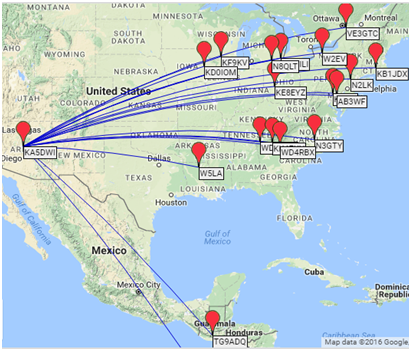
Rank    Call                 Grid Square      Distance     Captures                        
1           WD4RBX       EM84NN            1338             11724                               
2           WB8ILI           EN82OQ            1669             9234                                 
3           K8VGL           EM69UT            1245             7322                                 
4           K4RKM          EM85VF             1406             6995                                 
5           W4JKL           EM84AK            1238             5026                                 
6           AD4RX           EL88OD             1475             4443                                 
7           KC9MEG       EN52TI               1310             3106                                 
8           KD5LWU       DM57RI              1145             2955                                 
9           K4EPS           EL86UW            1579             2887                                 
10         N7YG             DM42NF            1282             2828                                 
11         K1MEA          DM33TP            1412             1821                                 
12         KI4EIZ            EM63KN            941               1770                                 
13         NZ9Z              EN64BD            1492             1716                                 
14         NM4V             FM06NR            1748             1655                                 
15         N4LR              EM73QN            1172             1626                                 
16         KF9KV           EN52ET             1291             1249                                 
17         N4PSN          EM84KP            1319             1245                                 
18         KC0EFC        EM28OX            715               1004                                 
19         KI0GU            EN35HF             1413             974                                   
20         KF6XA           DM13JO            1859             936                                   
21         W2EV             FN03XD             2026             932                                   
22         WN4AMO      EL98CW            1532             861                                   
23         W6CGH         DM13BR            1920             735                                   
24         N8QLT           EN82HL             1617             707                                   
25         N0OBG          EM48RO            877               705                                   
26         KC6QJO        DM05KH            2035             701
27         W3GYK          EM85VF            1409             620
28         W3NRG         DM12JQ            1867             568
29         WN3C            FM19QC            1975             539
30         AB0TJ            DN60CN            1277             514
31         WB8SKP       EM56WR           933              509
32         KP3FT           FK68QA             3467             502
 73s Art Jackson KA5DWI

Saturday, March 18, 2017

Ode to RadioShack

Way Back When in a City Far Far Away.....
If you have been around as long as I have, you have a history with RadioShack. Recent news seems to indicate that RadioShack's days are numbered. I am saddened. Maybe I am a bit sentimental, but their products have given me years of DX'ing excitement and enjoyment. A very large piece of my DX'ing over the years utilized products, equipment and peripherals sold by RadioShack.

My working-class parents bought me my first Shortwave communications receiver in 1965 at a Bellaire, Texas RadioShack, a 4-tube Halicrafters S-120 for a whopping $69.95 . It was the bottom of the line for Shortwave receivers, but it opened up the wonders of this hobby. It was a thrill listening to broadcasters such as, Radio Moskow, Deutsche Welle, Radio Australia and hundreds of Amateur Radio operators throughout the world, plus Citizens Band radio. This begat my first Archer 20 mW CB Walkie-Talkie for $14.95 and now I was trying to communicate beyond the line of sight, or least out of the neighborhood.

As a teenager, I focused on High School (hated it for the most part), girls, cars, a garage band and a bunch of trouble. The radio hobby took a back seat, although the interest was always still there off and on through the stresses of growing up. I graduated high school in 1970 and a year later began a 30 year career in Banking. Tandy stock had to have increased.

I moved from Houston to the Mid Cities outside Fort Worth Texas in 1978 and worked a block away from the Tandy Center in downtown Ft.Worth. It was a unique office and major shopping/entertainment complex in a downtown setting served by a Tram from a large parking lot a mile away.

So here is what is left of my collection from RadioShack and its uses they have been for me in the past and now. There are some articles I no longer have, and will mention them.

Pictures of the Collection:

Left to Right:
1. My second Shortwave communications receiver was a Realistic DX-150A (1971) It became my Ham Band receiver in 1979 when I became a Novice (same call as today). Used it for the first 10 months as a Ham, then switched to a TenTec transceiver. It still works, but needs alignment for the higher bands.
2. My first CB radio was a Realistic Navaho (1971). One fine CB Rig. I used a RS Quarter-wave Ground Plane, a Super Maxim (end fed half wave ground plane), a four element Yagi and a mobile antenna made by Antenna Specialists (Hustler brand). I worked a little Skip with it barefoot. One time DX mobile on the Southwest Freeway in Houston. The radio was converted to 10-Meters in 1981 and worked all over North America using the old CB Yagi and on a few long road trips. Does W-A-1-H"Yell"Rrrrr ring a bell? Works now on 75% of the channels (24) because one crystal went bad.
3. A DX-351 LW/MW/SW/FM radio purchased on clearance in 1997. Analog and a surprising good receiver with external antenna help. Excellent battery life. Used when I traveled.  TECSUN sells a similar radio today.
4. Realistic headphones from the advent of the Walkman days.

My original Archer FM/VHF/UHF-TV V125 Log-Periodic antenna purchased in 1974 to watch the Indy 500 while I was fishing down at a Bay home on the SE Texas coast. The UHF elements were cut off in 2013 because of rust and corrosion. By the way, the 3-element 10-Meter Yagi on the tower is my original CB Yagi (Hustler). Not pictured is a RadioShack FM Turnstile (crossed folded dipoles) mounted 20 feet up the tower. I gave away 2 other outdoor RS VHF/UHF TV antennas over the years.

Left to Right:
1. Micronta 12-24 Hour Alarm Clock- Circa 1982 with bright blue LED's. It replaced a RS Weather Radio Alert Clock with Red LED's. It is much easier to read than my computer when paper logging QSO's.
2. Pro-74 VHF/UHF/Race Scanner (29-956 MHz). The only gift in this collection. My wife gave it to me for Xmas in 2000. It was last used in 2016 at the Phoenix IndyCar race and in 2013 at the Indianapolis 500. I also use it for 6 &10 Meter FM, Aircraft, Weather Radio and Satellite monitoring.
3. 49 MHz Walkie-Talkie with a Code Key (orange button). Changed a crystal to use it on 6 Meter AM (50.4 MHz). No luck with that. It does hear, but not transmit.
4. Realistic's copy of the Turner+2 amplified desk microphone. Still works. I use it with my Yaesu FT-726R and FT-747GX on occasion.
5. Noise cancelling amplified Trucker microphone. Used with my 2 Meter all-mode Yaesu FT-290R that is notorious for very hot microphone input. It used a 7V battery that is no longer made. I will have to manufacture something (watch batteries in series) one day.
6. DC-AC Voltage/Ohm/Amp Meter - Purchased in the mid 1980's. Takes a licking, keeps on ticking. Not 100% accurate, but still good for simple applications.
7. Archer TV Antenna Rotor. Besides rotating a TV antenna, it was used to spin around a Cushcraft 3-element 6-Meter and 424B 70 CM Yagis for 10 years. Still works after greasing the gears on the rotor. Always required re-adjusting. I have 100 feet of unused RS 3-conductor rotor cable. The CDE (Ham-IV) rotor was not sold by RadioShack. At one time I had a larger Archer rotor to spin the CB Yagi. It died in a flood while in storage in Houston. 
8. Ceramic microphone used on the Navaho CB rig.  

Left to Right:
1. Realistic Stereo Pre-Amplifier primarily used to amplify record turntables into stereo amplifiers that did not have a Phono input (8 track/Cassette/Early CD era). I used it a lot to record a number of my Psychedelic era LP's to CD on my desktop computer.
2. One of  two Mono-Computer Headsets /w microphone. One used on my Yaesu FT-290R, the other on my Wouxon U/V handie-talkie. I also have a third spare.
3. RadioShack AM Broadcast Loop Antenna. It can be used as a passive loop (placed next to internal antenna) or has a mini-plug connection for radios/receivers that have external AM antenna ports (current use Kenwood or Pioneer Stereo Receivers). I have used the antenna when traveling and as an extra boost loading a 4-Foot Box-Loop. Today, Kaito sells a look-alike of this antenna. 
4. Optimus 12-603A AM/FM Radio. This a GE Superadio III copycat and supposedly the main board is made by the same company that makes the GE SR. It has external antenna ports for AM and FM. It was not a good performer out of the box and I had to re-align it. I remember in Fort Worth Texas using the radio with my 4-foot box loop one early evening listening to afternoon traffic reports from a Phoenix/Mesa Arizona AM broadcast station.
5. Realistic Power/SWR/Modulation Meter. I really think this device was designed for CB'ers that operated illegal power amplifiers (has setting for 500 watts). This meter has been a godsend. It works efficiently and accurately from 80 Meters all the way to 6 and 2 Meters. The antenna and rig connectors detach from meter box for easy hook up.

My last purchase for Amateur Radio at RadioShack. A HTX-10, a 25-watt all mode 10 Meter transceiver. I bought it in 2004 when Radio Shack was getting out of selling Ham equipment. It was purchased for $44.95 and was the last one in stock at a Hurst Texas RS.  I have worked some of DX mobile with it, but it really has been a workhorse with my 10 Meter PropNET efforts. Used as a Lurker rig, it has captured PSK31 packets and CQs for real-time plotting and database analysis for more than 10 years. Its broad-banded front end is great for picking up PSK31 signals in a 3,000 Hz range.  I plan to put it back in use for the Spring/Summer Es season on PropNET or WSPR.

Other articles:
1. Apartment Spring-loaded vertical CB Antenna (end-fed coiled 1/2 wave). Worked better in the attic.
2. A few hundred feet of RG8-X. The only coax that Tandy made that was decent. Still have some feeding an HF Vertical. Their RG58 & RG8 (RG213) was not very good. I also use a 110' Inverted-V Doublet with RS High-Quality 300-Ohm feedline. It about 40 years old.
3. A few hundred feet of 75-ohm RG59 & RG6. Some good, some bad. Still have some.
4. A collection of RG58 patch-cables. None worth 50 cents.
5. 5-Inch Black&White 12V Portable TV with a glass mounted V-shaped antenna. It kept the daughter entertained on road trips and me informed on VHF propagation on my road travels. Still pissed that we converted to HDTV. 
6.  Several VHF and UHF outdoor and indoor antennas for my Scanner and Radio Shack Patrolman receivers. The reception of distant NOAA Weather and Fire/Police stations was my introduction to Tropo.

Thank you RadioShack for passing the time and enjoyment in this hobby.

Their liquidation has started similar to what has happened at K-Mart. Retail prices have been raised 50% with a 20% reduction. Way overpriced!! I will patiently wait. There are a few final odds and ends I want to buy before they shut the door for good.

73 Art Jackson KA5DWI

Epilogue:
My local Radio Shack closed on May 30, 2017.
I was surprised that many components and parts were purchased in mass by several individuals.
Besides getting a few antenna (TV & Cable) and electrical parts before someone bought them out, I honored Radio Shack by buying a FM/AM/SW Travel Radio for $25. It works well with the RS MWBC Passive Loop and a 1-Foot Box Loop (Idaho and Washington logged). I even experienced a semi-rare propagation event. A couple of weeks ago, I heard five WWV Ft.Collins CO stations at the same time (5, 10, 15, 20 & 25 MHz) with its whip antenna. A major Sporadic Es event was going on.

Epilogue #2:
I picked up a DX-440 from a antique store that wasn't working. Turned out the memory/clock batteries hadn't been replaced and were badly corroded. Removed, cleaned and replaced. Not a bad radio for its age. A flaky dial, but overall a fun radio to play with.


A lot of fun done cheap.
73 Art

Thursday, January 26, 2017

It Might Not Be As Bad As What Has Been Predicted

Update December 2017... okay so I was a little late....not much read on this one
As I have said on this Blog, I am numbers person. Figures tell everything and trend-lines explain what has happened, what might or will happen.

Wondering what is happening.
Out of my natural curiosity, I have started plotting past solar indices in order to get an indication of what our next Solar Cycle (25) might look like.

A year ago, it was announced by a Space Weather Meteorologist, Tamitha Skov
( https://www.youtube.com/user/SpWxfx  https://twitter.com/TamithaSkov )
that the first sunspot for Cycle 25 had appeared.

Once I thought about it, I looked at the most recent Solar Flux plot of Cycle 24. It certainly appeared that it was dropping rapidly.  I thought it could be contrary to prediction that our next solar cycle would be worse than this one.


This is a plot of monthly 10.7 cm (2,800 MHz) Solar Flux since 1991 and encompasses 3 Solar Cycles. Solar Flux measurements have been done for 6 cycles and is he standard set for measuring solar activity. As you can tell by these graphs, Cycle 24 was way less active than the previous 2 cycles.

One the reasons for this less active cycle (24) was made aware to me in 2011 by Jim Kennedy, KH6/K6MIO. He shared at a VHF Conference that the reversing of the northern and southern magnetic poles were out of sync. 
As of today, the polar fields don't appear to be out of sync as they have this cycle.

With the appearance of a new solar cycle sunspot, I thought I would look into the decline of the current one. I plotted the monthly solar flux values individually from each cycle's peak for the last 3 solar cycles. I applied "Exponential" trend-lines (lines of best fit) and assured that there was a high level correlation (perfect = 1.00). Since monthly values are erratic, the peak to valley data charted was based on the monthly "Smoothed Solar Flux" value.
The chart shows that this Solar Cycle 24 is declining at a pace more closer to Cycle 22 than the pace of Cycle 23.  The decline of Cycle 23 foretold an extended lull between cycles and the eventual lower Solar Flux (solar activity) that followed in Cycle 24.

I have averaged out the rate for the first 42 months of decline. The decline of Cycle 23 was much slower than 22.  Cycle 24 was declining move closely to the rate of Cycle 22. In the past several months the rapid decline has slowed. Important, Cycle 24 started its decline at a much lower solar flux value. 
Mathematically, this is the average decline between each month once these cycles started its end.
The Mathematical term is slope.

The lowest level of 10.7 cm Solar Flux that will be experienced is close to 65. At the current rate, we should see the bottom of Cycle 24 soon. The low rate of decline in Cycle 23 resulted in a low rate of incline for Cycle 24. The higher rate of decline in Cycle 22 made the bottom more short-lived and resulted in a sharper incline for Cycle 23.
  The lull between Solar Cycles 22 & 23 lasted 30 months. The lull between Solar Cycles 23 & 24 lasted 50 months, and its decline and rise were somewhat equal.

The only hitch to this analysis has been a constant elevated level of geomagnetic activity. Although solar activity has declined since 2014, geomagnetic activity has not. The values had actually increased somewhat and still flared up now and then. After a 3 month drop early in 2017, it shot back up.

The Conclusion:
The current rate of solar activity decline equates that this solar cycle should reach bottom within 5-6 months. After my July report a short but active period slowed the rate of decline. Solar activity returned to low levels. Any lengthy spurts of activity (new sunspots) lasting several sun rotations would change the prediction. If the rapidly declining trend occurs and we hit bottom soon, it should equate to a healthy rise of solar activity for the new cycle. Once we are into a year of increasing solar activity, a more reliable prediction for Solar Cycle 25 can be made. I still do not believe it will be as bad as predicted.

A reminder, I am not a physicist.
I have looked at numbers and charts for over 40 years to identify patterns and trends.
I am an optimist. I am still not convinced the next solar cycle will a stinker.  I want to work more 6-Meter F2 before I meet my maker.... 😏 in honor of SMIRK and earn a 10-Meter DXCC on LOTW (3 Current short). 

73 Thanks for reading.
Art Jackson KA5DWI

Friday, January 13, 2017

Loss of a VHF Propagation Pioneer/Reseacher - Pat Dyer WA5IYX

Good morning.
One of the sad things about our hobby is that we losing many of the pioneers and researchers that have made this hobby so fascinating.


I learned this morning that P.J. (Pat) Dyer, WA5IYX passed away in December 2016.
From my personal observations, Pat had dedicated his entire life to the research of VHF Propagation, especially Sporadic Es. To the best of my knowledge, he was contributing up to the last minutes of his life.

Pat's family appeared to be only VHF/UHF propagation research. His family in VHF/UHF/WeakSignal are going to miss him for a long time.

Pat should be considered the Father of Sporadic Es. He was very instrumental in identifying the "Diurnal" patterns with this propagation phenomena.
Most of my first draft Papers and Blog postings concerning multi-year observations and analyses were sent to Pat for his comment and feedback.

If anyone wants to understand Es more, you have to visit his website. He maintained some absolute meticulous records. I wish I had done the same, but getting married twice and four re-locations resulted in a loss of most of my records.
I am going to get hold of some of the VHF groups around here and see if we can't honor him by giving his last name to a VHF propagation phenomena.
RIP Pat.
73 Art Jackson KA5DWI/7 Near Prescott Arizona  

Wednesday, January 4, 2017

The Sun Was Active

2017 Begins
The Solar Cycle is spiraling down and 2 persistent Coronal Holes won't ease up.
Take that, and the Winter Solstice and you get no F2 and limited Es on 10-Meters.
So goes life. No reason to give up. Expect a Winter Es opening now and then into February.
The Spring and Summer should be fun if the Coronal Holes ease up.
Never give up.
12/24/2016 - 01/04/2017
A lack of Sun during the solstice, plus lots of geomagnetic activity results in a thin map.  The Quadrantids Meteor Shower help a little bit. These was the barest map I have seen in over 10 years.

Hang in there.
73 Art KA5DWI/7

Thursday, September 29, 2016

The Sun is Still Active

Howdy,
The sun has been active after the Fall Equinox. Not a lot of sunspots, but lots of geomagnetic activity.
A and K Indices have been elevated for a couple of weeks. The result is some nice propagation on 10 Meters at times. October usually is a good month in years of high solar activity. It looks like it won't disappoint us.
All of the following maps are 24 hour captures on 10-Meter WSPR.
 09/26/2016
09/28/2016
09/29/2016
10/02/2016
10/03/2016
10/04/2016
10/05/2016
I took a few days off.

10/12/2016 Nice opening to Australia and New Zealand.
10/13/2016 Despite a G1-G2 Geomagnetic Storm.
11/01/2016
 I have been off for a few days. Despite low solar activity, it is still open.

11/04/2016
I am always amazed how the band changes day to day. Yesterday, VK, ZL & an E5 filled the waterfall during the afternoon.

11/23/2016
The Sun has been quiet for the remainder of November. There has been a couple of days with activity, but overall DX has been limited.  Today the first good Fall/Winter opening on 10-Meters occurred. For about 6 hours there was occasional paths in all directions. I strongly believe that meteor showers are an influence. It isn't a meteor that causes it, but residual ionization left by them that stirs up the Es layer.

I have replaced the desktop computer running WSPR and have had issues with the rig interface. Meanwhile in order to utilize the computer, I have switched back to PropNET (PSK31 Realtime Propagation Reporting).
5 Days
12/05-09/2016

7 Days.
12/16-23/2016
F2 opportunities were nil as solar activity was very low. I would call this propagation chordal interaction of the E and F layers. Openings were short in duration, but pretty good when it opened up. They occurred usually late morning, mid-day and late afternoon.
I noticed that some of these openings occurred just prior to a geomagnetic disturbance. Despite low sunspot numbers, several large coronal holes continue to produce streams to later disturb the ionosphere. Trans-Equatorial propagation is a usual result.

As I have said many times...
Don't give up on this band.

73 Art KA5DWI/7